Structural integration in movable glass roofs.
In the development of glazed retractable roofs, structural integration remains one of the most decisive aspects — and, at the same time, one of the most underestimated during the project design stage. While attention is often focused on design or thermal performance, on-site reality shows that most serious issues originate at a structural level.
A retractable roof is not a passive element. It is a dynamic system that introduces variable loads, movement and operating conditions that differ radically from those of a fixed roof. This means its integration within the building’s structural calculations must be completely reconsidered.
One of the most common mistakes is to size the supporting structure as if it were a conventional lightweight roof. This approach overlooks key aspects such as the dynamic loads generated by movement, load concentrations at support points, and the tolerances required for the system to operate correctly.
From a technical standpoint, a retractable roof must be analysed in multiple scenarios: fully closed, partially open and fully retracted. Each of these configurations generates different load combinations that must be verified in accordance with Eurocode criteria.
In particular, wind actions play a critical role. In the open position, the system may behave as an exposed structure with high suction effects. In the closed position, it acts as a continuous surface that transfers loads to the main structure.
This dual behaviour is one of the factors that adds the greatest complexity to the calculations, and explains why most standard solutions fail when applied to real, highly demanding projects.
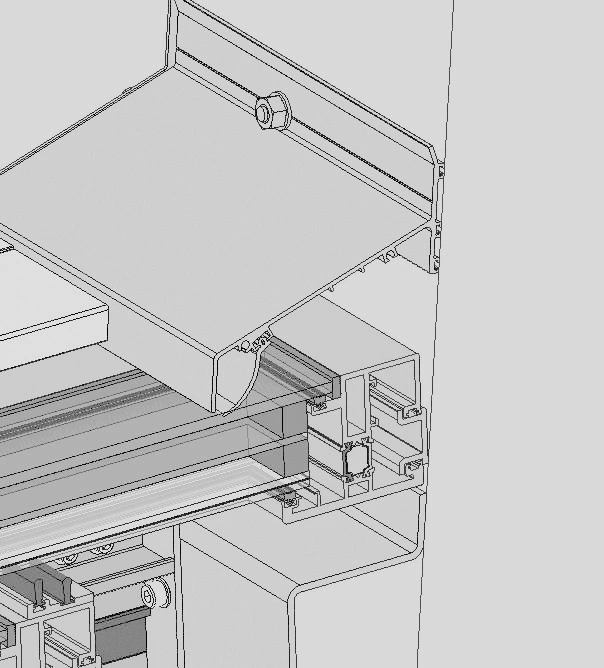
In systems such as AIRCLOS T7003 RPT, structural integration is approached from the logic of a complete system. It is not simply a set of moving panels, but a system in which guides, profiles, supports and structure work together to transfer loads in a controlled way.
One of the key aspects is the correct definition of the support points. The concentration of loads in specific areas can generate excessive deflection if the structure is not properly sized. This can lead to operational issues, system blockages or premature wear.
Another critical factor is deflection control. Unlike other construction elements, in a retractable roof, even small deviations can directly affect the sliding movement of the panels. For this reason, permissible deflection limits must be more restrictive than in conventional structures.
Installation tolerances are equally decisive. Failing to allow for on-site adjustments can create misalignments that compromise both the watertightness and the mechanical operation of the system.
From a regulatory standpoint, the structural justification must be based on the Eurocodes, integrating wind, snow and imposed loads, as well as specific load combinations for retractable systems. This justification must form part of the project and should not be resolved afterwards.
In hospitality projects, where spans are usually greater and usage demands are more intensive, these aspects become even more relevant. Structural integration is no longer a secondary variable; it becomes the central axis of the design.
Therefore, the correct specification of a retractable roof requires real coordination between architecture, engineering and the system itself. It is not about adapting the system to the existing structure, but about designing the structure around the system.
In conclusion, most failures in retractable roofs are not caused by limitations of the system itself, but by incorrect structural integration. Approaching the project from a global perspective, considering loads, deflections and dynamic behaviour, is the only way to guarantee a reliable result.
In solutions developed with an engineering-led approach, such as AIRCLOS, this integration is not an add-on, but the starting point. It is what allows a retractable roof to become a robust, precise and durable architectural system.

Become a Premium Partner — exclusive terms & priority support